

AI-Generated MATLAB Code
From AI-Generated to Production-Ready: The Essential Role of Static Analysis
Read articleCode Checker for MATLAB (CC4M) is a static analysis tool for MATLAB source code, including code written by AI coding agents. It checks code against configurable rules, with presets for the MathWorks MATLAB Coding Guidelines and the MonkeyProof Coding Standard for MATLAB. Run the checks in MATLAB Desktop or as part of your CI/CD pipeline.
See how an AI agent used CC4M findings

CC4M enhances productivity by automating standards compliance checking, eliminating the tedious aspects of code review. Developers can now concentrate on functionality, while compliance checks during development promote adherence to coding standards.
CC4M helps to ensure consistent code layout, checks naming conventions compliance, reports code complexity, and promotes recognizable structures. This fosters quicker onboarding of new team members while enhancing code readability, maintainability, and reusability.
Prepare MATLAB code for generation of C/C++ production code, be it using the MathWorks MATLAB Coder or using dSPACEs TargetLink. CC4M reports compatibility issues with respect to used functionality and programming features. Additionally, it flags potential functional disparities between m-code and generated code.
CC4M offers checks that enhance testability, verify code completeness, and manage complexity, making defect detection during test development easier and more efficient. Additionaly, a set of checks prevent possible violations of MISRA Standards when generating C/C++ code. In short, CC4M helps reducing overall defect costs.
CC4M stays up to date with MATLAB releases. In industry projects are often stabilized on a specific MATLAB release. CC4M recognizes this by supporting a range of historic MATLAB releases. Supported MATLAB releases: R2017b - R2026a
Next to CC4M availability as a MATLAB Desktop tool, it supports a server/runner based CI/CD and quality dashboarding. GitHub and GitLab integration information available on request. TIOBE TiCS software quality dashboard integrates natively with CC4M.
CC4M provides a variety of MATLAB Coding Standards tailored for various purposes, all conveniently accessible online. With an included configuration set, CC4M ensures compliance effortlessly. Whether adopting these standards outright or utilizing them as a foundation for customization, you have the flexibility to align them with your specific needs or pre-existing coding standards.
Crafted through collaboration with prominent companies employing MATLAB extensively, the MonkeyProof Coding Standard for MATLAB benefits from years of industry expertise. Their invaluable input guides the establishment of essential MATLAB-related coding rules. Notably, the standard is endorsed by TIOBE TiCS and supported by CEO Paul Jansen, who actively engages in the CCB.
In 2025 MathWorks published the MATLAB Coding Guidelines .
CC4M includes a predefined configuration that covers many of the guidelines as documented in MATLAB Coding Guidelines (mapped to CC4M checks)".
Generating C/C++ code from MATLAB using the MATLAB Coder necessitates adhering to a stricter coding style, utilizing a subset of functions, options, and structures. The prescribed rules not only facilitate the proper utilization of this subset but also identify and caution against potential discrepancies in behavior between MATLAB and the generated code.
When deploying algorithms or apps using the MATLAB Compiler (SDK), the MATLAB code must be robust, secure, and following the (MathWorks) documented and undocumented constraints. CC4M comes with a configuration that checks for this.
Generating C/C++ code from Simulink models using the dSPACE TargetLink, has different contraints on the included MATLAB code, compared to the simuliation requirements. CC4M checks compatibility of all the MATLAB code in a Simulink model with the documented subset of features and functions.
A practical starting point for adopting coding guidelines is to define a limited set of conventions, apply them consistently, and expand them as experience grows. This blog discusses typical starting strategies and common implementation considerations.
Introduction to CC4M
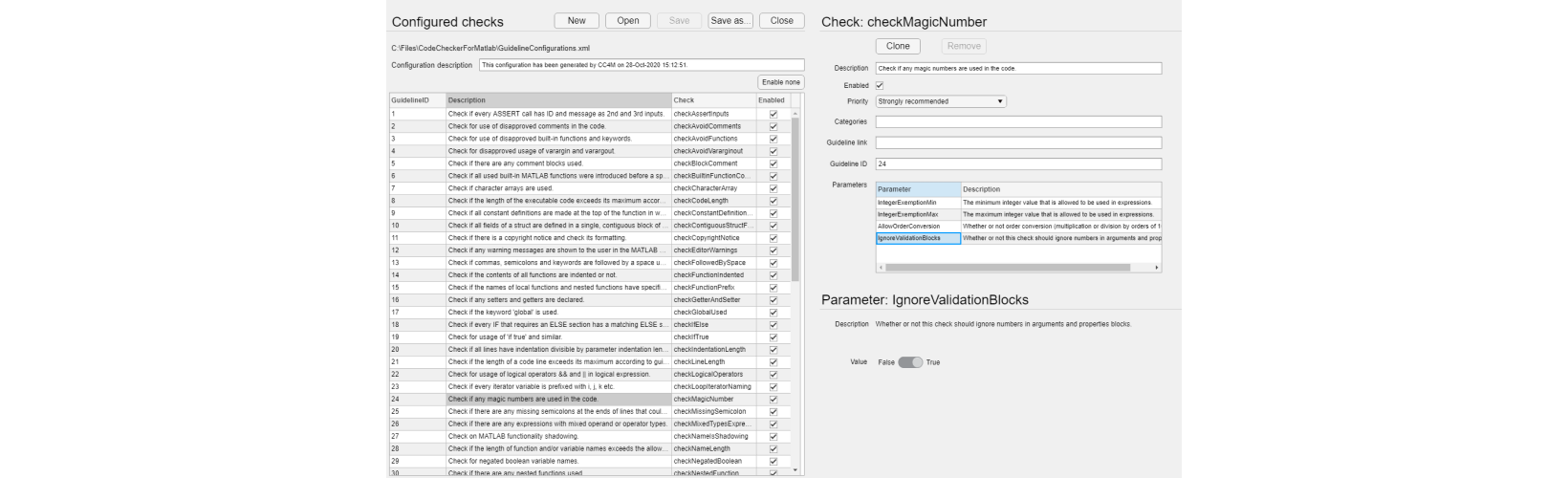
CC4M provides a wide array of customizable checks, accompanied by multiple available configurations. Each configuration includes a distinct set of checks, each with its own specified parameter values. Parametric checks can be duplicated within a configuration, allowing for variations in parameters, and each parametrized check can correspond to a coding rule. During the checking processes, CC4M seamlessly utilizes the selected configuration.
Verification of generic programming features and constructions not categorized under "functions to avoid" or any other specific category.
Checks, some equipped with auto-fixing capabilities, ensuring adherence to preferred comma usage, spacing, line endings, alignment, comments, and more.
Ensure compatibility with designated MATLAB releases, identify JAVA usage, and pinpoint features or functions that could pose compatibility concerns, especially during deployment.
CC4M conducts multiple checks on the casing of specific elements in the code, with individual checks for each aspect. This enables customization of parameter values for each casing check.
Includes checks aimed at enhancing testability and managing code complexity, along with evaluations of function/method prototypes.
Security checks, as outlined in the MATLAB Coding Standard, are particularly advised for application development.
Customize Your MATLAB Coding Rules with CC4M’s Configuration Editor
We are proud to partner with MathWorks and extend the value of its Startup Program with CC4M - Code Checker for MATLAB.
Turn your ideas into impact faster! CC4M helps startups move from concept to production with confidence. Automatically check, refine, and optimize your MATLAB code to ensure quality, consistency, and speed as you grow.
Frequently Asked Questions & Answers.
CC4M empowers developers to craft clean, uniform, and guideline-adherent MATLAB code. Seamlessly integrated into the MATLAB editor and Simulink Model Advisor, it rigorously checks MATLAB code, Simulink models, and Stateflow charts for consistency and errors.
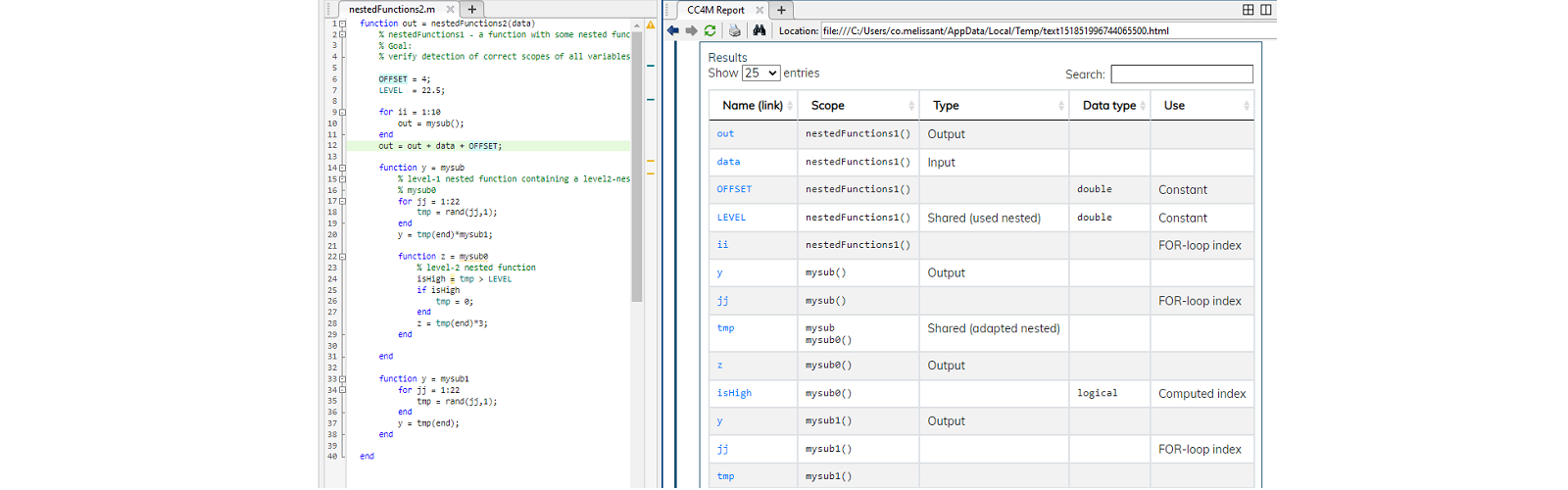
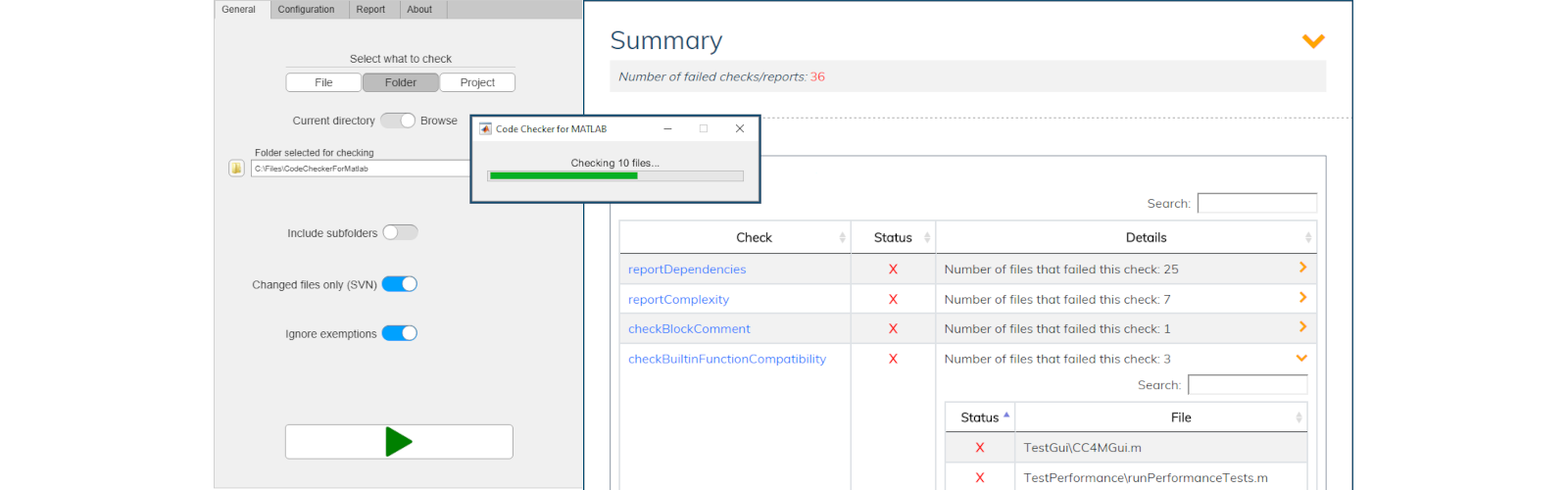
CC4M carefully examines your MATLAB code, providing essential insights into functions and variables. It ensures adherence to guidelines, spots function shadowing, and detects missing dependencies. Work efficiently with CC4M, accessing navigation links to locate the precise code location for each failed check.